Primary Research and Defining Product Scope

After 100+ customer calls with horse vets, trainers, owners, grooms, and managers, I found that most barns already know the warning signs, but they don't have eyes on the horse when it matters.
Understanding this shaped how we decided to approach building the AI model. Instead of trying to detect every possible symptom out of the gate, we started with rolling, repeated lying and standing, and prolonged lying down because these are three symptoms very reliably detectable through computer vision analysis. Narrowing the scope let us build something accurate and trustworthy first, with room to expand detection capabilities as the model matured.
From my calls, I built connections with two barns that graciously allowed me to install a training camera into one of their horses' stalls. This gave my team real footage of natural horse behavior over time, which became the foundation for training the model to distinguish normal resting behavior from the rolling and prolonged lying patterns associated with colic.
Thank you to Sunset Equine Farms, Stanford Equestrian, Animals in Motion, and Dawson Grove Farm for being an integral part of helping me install these cameras.
Building Process
Core Features
Mitigating Friction
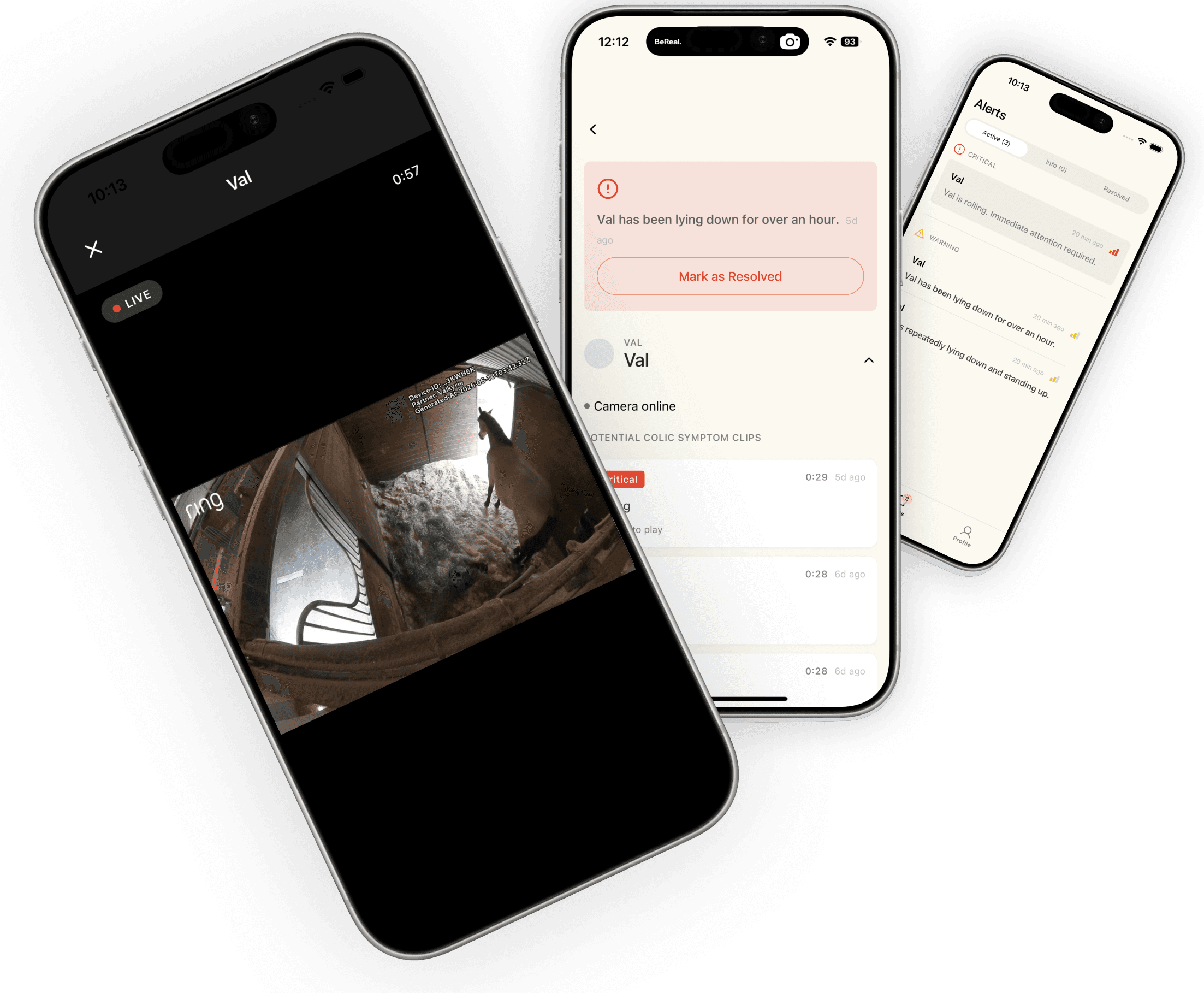
Instant Notifications
Real-time alerts the moment concerning behavior is detected.
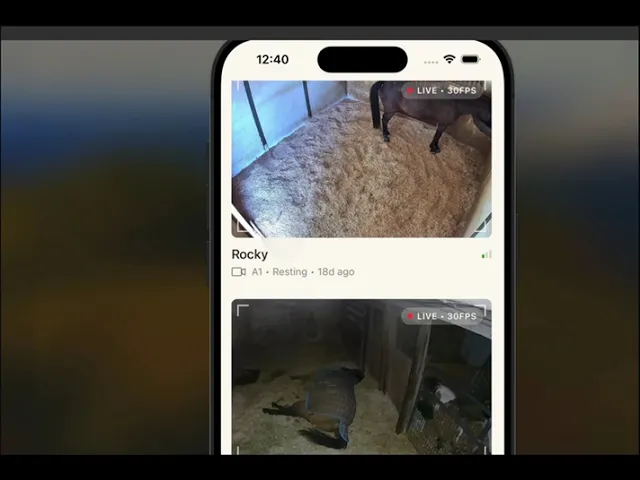
Live Views
Real-time access to a horse's stall from anywhere, letting owners check in the moment something feels off instead of waiting to physically get to the barn.
Replayable Colic Clips
Short, saved clips of flagged behavior that give owners visual context behind every alert.
Challenge: Finding the Camera Hardware
Solution: Rather than building proprietary camera hardware, I reached out to Ring to see if they’d be willing to work with us. From this, we secured a partnership with Ring, which offers both battery-powered and outlet cameras that connect directly to our app, reducing hardware cost and installation friction for barns.
Pictured above is Sunset Equine Farms (left) and Animals in Motion (right) - two barns that very kindly allowed us to install cameras for training.


Challenge: Customer’s Limited Technology Experience
Solution: Our users range widely in tech comfort, so we stripped the app down to its core features and prioritized intuitive design. During onboarding, we built passwordless account linking to a customer's existing Ring account, removing the biggest point of friction in setup.
Growing up as an equestrian, I’ve seen several horses suffer from colic. Industry studies indicate that about 4% to 11% of horses will experience a colic episode each year.
Colic is a general term for abdominal pain in horses, and it's one of the leading causes of death in the species. In fact, colic accounts for approximately 28% of [horse] deaths every year.
Because horses have a long, complex digestive tract that's easily disrupted by diet changes, dehydration, stress, or parasites, even minor gut issues can escalate quickly. Early signs are often subtle (pawing, restlessness, looking at the flank, reduced appetite) and easy to miss during unsupervised hours, but delayed treatment - even by just a few hours - dramatically worsens outcomes both financially (surgery can cost $15K+) and for the horse.
This is what makes early detection so valuable: catching colic in its earliest stages gives owners and vets the time they need to intervene before it becomes a medical emergency.
The Problem
What is Colic?

Pictured above are Jimmy (left) and Cody (right) - two horses I helped train - who both had to undergo invasive colic surgery

Common Issue
Colic accounts for approximately 28% of [horse] deaths every year.
Visual Cues
Body language and behavior are strong indicators of early warning signs of illness.
Time Sensitive
One missed night can mean the difference between a vet visit and a $15,000+ surgery.
Video Demo and Apple + Ring App Store
Results


Pictured above is our app on the Apple App Store (left) and Ring App Store (right) - as of July 13, 2026 I have made the app unavailable due to my discontinuation of the startup
This video was produced in April 2026. Since then the design of the app has changed minorly.

Secured partnership with Ring
Won Lava Lab Demo Day
Uploaded onto the Apple App Store
Deployed in 2 barns
My Highlights

Thank you to my wonderful cofounders: Karen, Justin and Trent and the barns that supported us along the way.
Product Overview: Valkyrie turns your Ring camera into an equine health monitor built around early colic detection. When your horse's stall is active, Valkyrie analyzes the footage for early warning signs: rolling, repeated lying and standing, and prolonged lying down. You'll receive real-time alerts and can review flagged clips at any time, so you can catch the signs even when you're not at the barn.
I served as the Founder - Product, Partnerships, and Research on a team of 4.